
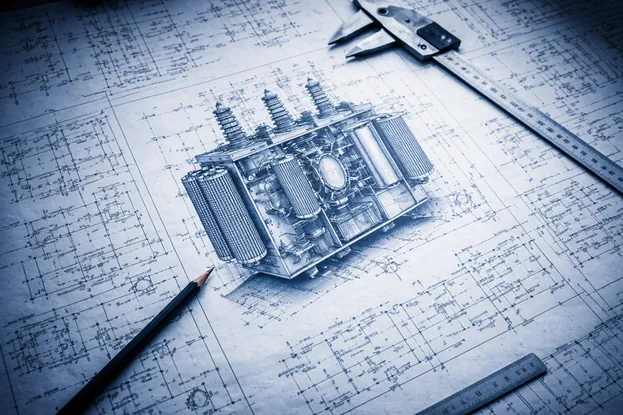
The objective is compliance with technical, operational and regulatory requirements, with the design validated against real operating conditions. We support manufacturers, utilities and end users throughout the project lifecycle.
Our design review is structured and in-depth, aligned with IEC standards and extended with advanced simulation and field-based validation, to minimise the risk of design or manufacturing defects.
Scope of support
- Validation of new transformer designs
- Review of transformer technical specifications
- Tender and procurement support
- Design optimisation (cost, performance, reliability)
- Compliance with international standards (IEC, IEEE)
Technical assessment
EWP combines document review, engineering validation and numerical simulation to assess every critical aspect of the design.
- Technical specification review
- Analysis of client requirements, operating conditions and project constraints to ensure clarity, completeness and feasibility.
- Electrical design assessment
- Insulation coordination and dielectric design, voltage distribution (steady-state and transient), losses and efficiency, short-circuit withstand capability.
- Electromagnetic and thermal analysis
- Independent validation that detects critical issues not visible with standard analytical methods, through numerical simulation:
- 2D FEM coupled electromagnetic-thermal studies: losses and hotspots in windings, current distribution, skin and proximity effects, impact of harmonic content, short-circuit electrodynamic stresses under multiple scenarios.
- 3D FEM transient electromagnetic-thermal studies: time-domain simulation with real current waveforms, analysis of tank, LV busbars and structural metal parts, stray and eddy loss distribution, local hotspots and leakage flux paths.
- Thermal and mechanical verification
- Cooling performance and temperature rise, mechanical strength and structural integrity under fault conditions, and consistency between analytical calculations and FEM results.
- Standards and compliance check
- Verification against IEC, IEEE and customer-specific requirements.
- Risk analysis and optimisation
- Design weaknesses and critical risk areas, opportunities to improve performance, reduce cost and increase reliability before manufacturing.
What you gain
- Lower technical and financial risk before manufacturing
- Compliance with project specifications and standards
- No costly redesigns or project delays
- Reliability and lifecycle performance validated under real operating conditions
EWP combines verification of manufacturer data, independent 2D and 3D FEM simulation and practical field experience. The result is a design that is not only compliant, but technically validated for real operating conditions and long-term reliability.
Next serviceSupplier Qualification